Friday, November 11, 2011

Veterans Day


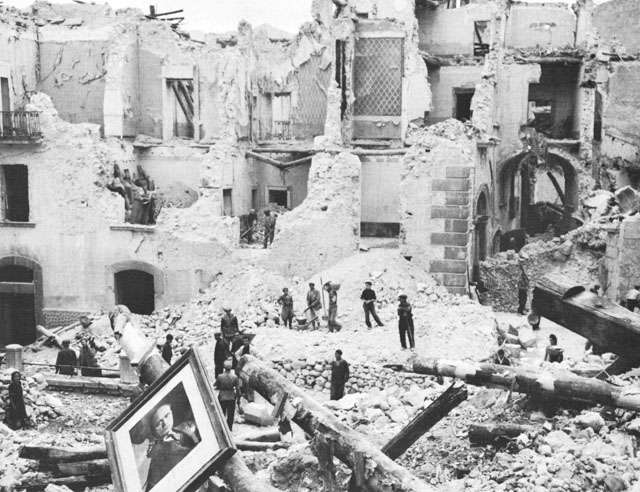
Salerno...

According to the most recent U.S. Census data, there are almost 22 million veterans living in America right now. Today, we celebrate them. Originally established as Armistice Day on November 11, 1919 to commemorate the first anniversary of the armistice of the Great War (as it was then known, prior to WW II), Veterans Day became what it is today in 1954 under President Eisenhower. So the history goes way back.

I’m reminded on this day of my Grampa Juraska. He fought in WW II as an Army buck Sergeant, a heavy machine gunner. The weapon system that his fire team used was the legendary Ma Duece—the M2 .50 cal. It’s still in service today, largely unchanged. My Grampa was in charge of the massively heavy tripod for this gun, as well as some of the ammo—I imagine every member of the team carried ammo—and his unit fought in Italy.

Italy was what Churchill called the “soft underbelly” of the Axis powers, and he was right. The Italians were largely fair weather friends to the Nazis, and Mussolini only became an attack dog when he felt it suited him because of easy prey. As a result, the Italians didn’t bring their A game, especially in Africa. Erwin Rommel, the 'Desert Fox,' said about the Italians, "Certainly they are no good at war." But after we beat the bastards, Germans included, back to El Alamein it was pretty obvious that our next move would be across the Med to Italy, so the Italians dug in and called their Nazi friends again for help.

sketch of the terrain at Salerno
At Salerno, where my Grampa fought, the battle went back and forth for days, and the terrain was nasty. Steep rocky ravines forced the battle into tight spaces where combatants relied mostly on speed and skill and fate. According to the story my Grampa told me years ago—only once—his team was maneuvering through one of these ravines to try to get into position and he lost his footing. He slipped and fell, the heavy tripod landing on him and knocking him out cold.

He awoke to probably four or five Germans encircling him at gunpoint, I can’t remember what he told me. The rest of his team was gone. He dealt with that abandonment for the rest of his life. He would, however, spend the next nineteen months of it in a Nazi POW camp in Germany, sleeping on dung and peeling potatoes. He really hated potatoes if I remember right.

And while this isn’t Memorial Day, remembering my Grampa is perfectly appropriate. He’s gone on to sleep until the Day of the coming of the Lord, but his example to me lives on in my own life. I was lucky, blessed, fortunate to have him in my life. My Grampa Juraska tought me about manhood. He taught me about manly virtues like honor and severity and fortitude. He taught me how to catch and gut a fish. How to change my oil, rotate my tires. And he was the one man in my life that I was thinking of when I became a U.S. Marine, because I wanted his approval; I wanted to see the look in his eyes that meant we shared something that can’t be put into words.

And I got that from him. When I came home on leave from boot camp, Grampa and I sat and talked about life in a way we never had before. I will always remember. I knew that he saw me different now; man to man even though I was only nineteen.

I’ll never forget my Grampa. He was a husband, father, working man, Army Sergeant, POW, bronze star recipient and World War II veteran. He was my Grampa, and I love him still. Thank God for our brave veterans. Thanks to Sgt. Albin Juraska's example, I am one too. Remember us today.

Thursday, November 10, 2011

Guest Post: D.G. Gass


The Stories Behind the Symbols

Poppies.  Close your eyes for a moment and think about the picture that word evokes. What do you see? Is it the scene from MGM's “The Wizard of Oz”, where Dorothy is running through the field of brilliant, technicolor flowers? Is it something a little more dark and nefarious, involving drug smugglers and gun runners? Perhaps it's something along the lines of a well-maintained garden bed, flowers dancing in the California sunshine.

For me, it's a small red flower, made of plastic and floral wire; a small tag with an imprint wrapped around it.  Much like your image, there's a story behind mine. A memory of standing in front of grocery stores and post offices on crisp November and May mornings in a girl scout uniform; a can in one hand and a bouquet of poppies in the other. For a nickle, a dime, or a quarter, you too could get a poppy to wear in your button hole, or wrap around your purse straps. Why do we do this? Well, because it was Poppy Day.

The story behind the poppy had gained more significance many years later. In a little hole-in-the-wall rib joint and bar outside of Oklahoma City, OK, a World War I veteran sat beside me, telling me about his time in Europe. It was the same type of story that I had heard from my father's uncle and again, years later from veterans in the VFW hall. It seems a lot of veteran's love to share “war” stories, especially if they realize there's a common bond.

Those individual tales may not be as dramatic as “Saving Private Ryan” or as epic as “Apocalypse Now”. And you more than likely will hear about the time they had to dig the latrine rather than storming the beach. Then there are some that are locked deep inside, never to be shared because of the personal demons that might be evoked dare they tell it.

The cast of characters is as varied and colorful as the yarns that are woven. The WWII veteran  who ignores the discomfort in his gnarled, arthritic fingers as he assembles the Buddy Poppy. The burly med tech with the braided pony tail, dressed in camouflage scrubs who reassures a crying wife that he'll take good care of her husband because he is his brother. The disciplined, but caring, nurse who not so long ago, was serving in a field hospital somewhere in the desert.

Tomorrow, November 11th, is “Poppy Day”, also known as Armistice Day, Remembrance Day or, here in the United States, Veteran's Day. You might  happen to see the poppy that I talk about. The one that was inspired by the poem “In Flander's Field” by Canadian physician and Lieutenant Colonel John McCrae, ninety years ago.  If you do, drop a quarter in the can and when you're handed the poppy, think about the stories that are wrapped around it.


About D.G. Gass:

Inspired by Walt Whitman and Carolyn Keefe, author D.G. Gass, from a young age, has always loved to write. It just took 40-years for her to believe in her work enough for it not to find the trash when she finished. Originally from Jeannette, PA, the Yankee transplant, currently resides in Columbia, SC with her husband and daughter, not to mention, three cats that own her.
A veteran of the US Air Force, whose day job is in healthcare IT, the author has a passion for veterans issues, which is the driving force behind her first book, "Ghosts of Arlington". When she's not writing, she can be found curled up with a good book, working on handcrafts, or staring blankly at walls in a catatonic state.

Wednesday, November 9, 2011

Guest Post: John J. Cline


The Last Confederate Battle, a novel by John J. Cline, is the purely American story of three brothers who were plantation raised in the Deep South and who subsequently fought for the Confederate States of America in the War of Northern Aggression, better known to the world today as the Civil War or as The War Between the States.  Although the story is fiction, the history isn’t. 

People who love to read a good story will find themselves wrapped up in the intricacies of fictional and historical people trying to find some degree normalcy in a wartime setting.  It is, after all, a war that didn’t have to be fought.  It occurred in a nation where common sense was spurned by military and political arrogance that beguiled nearly everyone into thinking that the conflict would end within a few weeks, and that each side, North and South, was superior to the other.  It is a fictional tale of murder, suspense, political intrigue, war mongering, profiteering, love and honor.  Most of all, however, it is a tale of federalism versus state’s rights, a conflict that continues in perpetuity.

Andrew Jefferson Davis, Andy to friends and family, is the youngest of three brothers who were raised on a plantation near the town of Madison, Georgia.  He was disillusioned by nearly four years of fighting and sat alone in the dark by a small campfire in what had been his plantation’s expansive front yard.  Uncharacteristically, he was sobbing uncontrollably.  During the war, he had seen unbelievable carnage and death, yet tears had never come.  It was only after he finally got home, after being released from a war prison, that he learned that his wife and young son had been tortured and murdered, and that the plantation had been burned to the ground; unusual because the plantation was only a few miles from Madison, one of only seven towns that had not been torched during Sherman’s March to the Sea.  So opens the saga of The Last Confederate Battle.

But this not a one-sided story!  Readers will glimpse into the human side of President Lincoln as he manages a war he doesn’t want to have to fight, while simultaneously digging through a myriad of political and criminal distractions that bleed much of his time and patience.   Readers will also meet Allan Pinkerton whose job it is to protect the President when he leaves the district, but who is also responsible for the collection of intelligence with which to prosecute the war.  Fictional character Franklin Stone is drafted by the president to investigate a series of murders and war profiteering because Washington D.C. at that time, had no police force.  He is pitted against some really ruthless and politically powerful people.  But who is really worse: the killer and war-profiteer or the shady consortium of big businesses who want to dominate the nation’s economy? 

The story behind the story!  Numerous readers have questioned me about the inspiration for writing The Last Confederate Battle, and the truth is just as bizarre as the story itself.  I was sitting on my patio waiting for the sun to rise (I’m an early riser) when this mental picture of a Confederate soldier squatting alone beside a late night campfire in the front yard of his burned-out shell of a plantation house came to mind.  At the time, I disregarded the image, wondering why I had thought of it in the first place.  But the image would not go away.  It kept coming back to the point where I finally had to start asking some questions.  Why was he there?  Why was he alone?  Where had he been?  What had happened to him?  Well, after asking a bunch of simple questions, it got more and more intriguing, and I just had to write the story that I was seeing in my mind’s eye. 

About the Author - Recognized as one of Idaho's Top Fifty Authors for 2011, John J. Cline has written several books, the most recent being "Sea Stories & Navy Tales," and "The Last Confederate Battle.  He is currently working on a book that is tentatively titled, "Rebuilding American Dreams;" a continuation of the stories told in "The Last Confederate Battle."   "Rebuilding American Dreams" should be available by early 2012. He has also composed music including, "Sunset in the Harbor," "American Bridal Waltz," and "Song of Idaho."  His website also has a number of short stories that can be viewed at www.theboiseauthor.com.

Before turning to writing, John spent 25 years in the United States Navy in both the enlisted ranks (Master Chief Petty Officer), and in the officer corps, as a Limited Duty Officer (Mustang).  He retired from the Navy in July 1993 as a Lieutenant Commander.  He was the Navy's first designated Physical Security Officer (649X), responsible for military law enforcement, physical security, antiterrorism and emergency management programs at naval facilities throughout the Southwest Region of the United States, the Caribbean, Western Pacific and the Persian Gulf, both at sea and ashore. 

He is a graduate of the FBI National Academy (140th Session) and numerous antiterrorism, law enforcement and emergency management schools.  He has a Bachelor of Science Degree in Workforce Education and Curriculum Development from Southern Illinois University at Carbondale, and a Master’s Degree in National Security Studies: Homeland Security and Defense from the Naval Postgraduate School in Monterey, California.

Following retirement from the Navy, John was the director of the Idaho Bureau of Disaster Services, where he served the State of Idaho for ten years directing the State’s disaster mitigation and preparedness programs and coordinating the State’s response and recovery operations to overcome the effects of fire, flood, wind, ice and snow emergencies, landslides that isolated towns, and a most bizarre disaster, the escape of lions, tigers and hybrid wolves from a self-styled wild animal park.  During his ten years at the bureau, he directed the State’s response and recovery operations for over 50 local disasters, 25 state-declared major emergencies and disasters and four Presidentially-declared disasters, contributing to the overall physical and economic recovery of numerous Idaho communities.

John and his wife, Patricia, reside in Boise, Idaho.  They have three grown children, four grandchildren, and some really good friends.  

Website/Blog Page: www.theboiseauthor.com


Tuesday, November 8, 2011

Guest Post: Karen Malena


When I was fifteen years old, I put pen to paper, writing what I thought was the saddest, most dramatic story of all time.  An avid reader, and lover of movies, an imagination to surpass all others, I just knew I could do it.  As my mother began reading the story, I did not see the response which I had imagined.  She proceeded to burst into laughter.  Not exactly what I was looking for.  As I slunk away, my tail between my legs, I threw the story out, and didn’t try again to write for many years.

My first e book, Son of Mine, was published a few weeks ago by Trestle Press.  Nothing could have prepared me for this amazing journey.

For the last ten years, I had seriously been forming a heartfelt story in my mind.  I had been through many ups and downs in my own life, and listened to countless stories from other people.

A writers group through my amazing church began to help each of us critique one another’s works.  I had encouragement from several people telling me my story was worthy.  So my year long quest with Son of Mine began.

It is a young adult novella about Aaron DeAngelis, a twenty year old twin, who grew up under the regime of his verbally abusive, alcoholic  father.  The family owns a prosperous landscaping business, which Aaron helps his father run.  Born with a stuttering problem, Aaron lives with insecurity and self-hatred.  His brother, Jeff, perfect in every way, is favored by their dad, but the love between the brothers is evident from the start.  A night of wild partying , out-of-control drinking,  and the many years of self-loathing, pushes Aaron to seriously contemplate suicide.   Aaron survives a terrible motorcycle accident, but is left with many questions.     A strange, old man that works at a local grocery store, speaks words of faith over Aaron, which may change his life.

Although my tale begins darkly, and on some very serious notes, it has moments of hope, and  faith.

Growing up Italian, has prepared me for many heartwarming moments.  I want my love of people and love of God to be evident in my writing.  I received my gift of compassion from my upbringing.

I have worked in the dental field since I was eighteen years old.  I love to listen to stories from the patients, learning their hopes and dreams.  I am a wife, mother, daughter and good friend.  Please take the time to check out Amazon or Barnes and Noble online stores to purchase my new book, Son of Mine.  It has brought some people to tears, made others think and feel deeply.  Even though it was geared for young adults, I find people my own age enjoying it.The book is available on Amazon and Barnes & Noble online stores.  

I want to kindly thank Chris White for allowing me to guest post on the C.P. White Media Blog.

Karen Malena

Monday, November 7, 2011

Guest Post: Ben Sobieck

Screw It: How a Crime Author Learned to Write Humor

by Benjamin Sobieck

I never thought I could write humor. I'm a crime fiction guy through and through. But along comes a publisher named Giovanni Gelati, of Trestle Press infamy, who offers the chance to do a collaboration with him on a short story.

The catch? Most of his other short story collaborations - although having a crime fiction bent - were humorous. You could call them, "crime fiction humor."

I remember thinking then, as I still do now, that writing humor has to be the most difficult genre to nail. The reader goes into the story expecting to not only be entertained, but also to laugh. There isn't a magic bullet with humor. My wife still doesn't "get" how The Simpsons is the least bit funny.

After letting this digest for a bit, I came up with a simple two-word solution:

"Screw it."

What that meant is that I wouldn't consider what other people thought was funny. The only thing that mattered is if I thought it was funny.

Not only did this relax my writing process, but it gave me a new way to vent my frustrations. The root of humor is tragedy, disappointment and anger. At the time of Giovanni's offering, I was still recovering from a kidney transplant, facing a mountain of medical debt. Writing humor gave me a way to cope with the situation. That's what makes the genre so valuable to writer and reader: It makes you feel better.

The result? A private detective named Maynard Soloman. He's profane, clueless and stuck in the 1930s, right down to his vocabulary. He was forced into retirement and got stiffed on medical bills. So he runs his own investigation business out of his dilapidated Winnebago RV. He's broke, pissed off and tired of wading through problem after problem. Just how I was feeling when I created him.

For shits and giggles, I threw him into a bunch of politically charged situations. Each short story addresses a different issue of the day. So far the topics have been the War on Drugs, Social Security and illegal immigration. It's all in the best satirical traditions, I'm not preaching a certain philosophy. I like using those issues as a backdrop for his cases.

And, man, is Maynard fun to write. Here's a bit from the newest installment, Maynard Soloman & The Job Nabbin' Illegal Immigrants. Maynard tries to order tacos at a drive-through, showing how removed he is from the times:

"I'll have six tacos," I say into the speaker. "I'm in a hurry, so no foolin' around back there. Just straight eggs in coffee, OK?"

Kids nowadays need a remindin' every now and then, see.

"Umm, we don't sell eggs in coffee. Just tacos," some voice on the other side of the speaker says.

"Now see here. Can't you understand proper English? Stop bein' a hard pill and make my gal-damn tacos," I say.

I thought kids were hip to my figure of speech. Eggs in coffee. That means smooth. Did people forget? Sometimes I feel like I'm on another planet.

"So you only want tacos then?" the voice says.

Why do I always have problems at drive-throughs? "Yes, you egg. Six. Gal. Damn. Tacos," I say.

"With two eggs?"

"No. You. Are. An. Egg. Egg means you're a crude, disrespectful person. Look it up," I say.

"Talk about the pot calling the kettle black," the voice says.

"Now what in the hell is that supposed to mean? I don't want a pot or a kettle. And don't burn my tacos black, egg," I say.

Twenty minutes and half a sawbuck later, I'm eatin' my tacos, curin' what ails me.

Or not. The doctors say I have a medical condition known as "chronic gut rot." It's gettin' worse every day. Makes me spit blood upstairs and downstairs, if you catch my drift. They say it'll put me in the boneyard if I don't watch my groceries.

It's tough for me to take 'em seriously. I have no money. I only have 180 pounds of piss and vinegar in a meat sack called Maynard Soloman. I'm countin' on that much to keep me out of the casket.
The reviews for the Maynard series have been overwhelmingly positive. I don't think that would've been the case had I tried harder to appeal to everyone. When you're having fun writing, the reader can tell.

So if you're looking to dip your toes into humor, remember: "Screw it."

-30-
Benjamin Sobieck is the author of the crime novel Cleansing Eden, the Maynard Soloman short story series and many flash fiction works. His website is crimefictionbook.com.

Saturday, November 5, 2011

Random Challenge


Writing challenge!

Give me 500 coherent words that mention the following words or phrases:

Michael Jackson, a hippo on rollerblades, cream cheese frosting, a 1972 Chevy Impala, emotional duress, a case of mistaken identity, an enigmatic old hag.

I’m taking it up this week. Anyone else have a random post for the C.P. White Media Blog? Give me 500 words or less on any seven (or more) phrases. Send it in to cpwreviews (at) gmail (dot) com and stick Random Challenge in the subject line. Here we go with the main event.

Beware the cheese.

Once upon a time there was this idiot writer who did something stupid: he put his underwear on backward without noticing. And while this might not seem like that big of a wrinkle, so to speak, it’s still kinda funny to think about how small a thing it takes to upset the balance of the entire known universe.

Anyway, like I said, this idiot writer didn’t notice that he put his underwear on backward. It wasn’t exactly emotional duress, but it caused him enough mild discomfort to make him irritable. So as the day wore on, he went from mildly unjolly right on past abnormally irritable and straight to flaming cantankerousness. And it was going to be ugly, by God.

And it’s funny what set him off. He was innocently walking the aisles of his friendly neighborhood grocery megastore when the muzak system started playing that old wretched Michael Jackson and Paul McCartney duet about some really creepy love triangle. And while that might not, again, seem like that big of a wrinkle, you’ve gotta admit that it’s one of those songs that gets in between your ears and stays there festering for weeks, like a rotten cabbage. Long story short, it put him in a right rotten mood.

And who should pick that exact moment to call but his incompetent and lazy literary agent? Of course, it figures, and who doesn’t like a bit of deus ex machina before dinner? It’s entirely apropos. Plus he answered the call by the bakery, concentrating quite hard on the wrinkle in his shorts, the hateful song blaring from the store’s speakers (the saxophone version, naturally), and pressing the little green button. He missed the fact that the baker was rolling a huge cake out from the double doors behind him.

How crazy, then, that as soon as he hears his agent’s strident voice on the other end of the line, that he should do a violent about-face in cantankerous annoyance, knocking the cake off the cart in a beautifully executed half-gainer? It’s not a stretch at all. Our intrepid scribe fell over cart onto the cake just enough to besmear himself from head to toe in cream cheese frosting. It was unfortunate, too that the baker, wildly off balance and suffering from shock, fell on top of him whilst he was crouched and waving his arms madly. Our author ended up catching his balance basically in a puddle of cake and giving the baker a complimentary piggyback ride. The result looked like a hippo on rollerblades.

And who should appear from the cheese case then but an enigmatic old hag, calling out, “Bernice! Bernice!” It turned out she had a friend by that name. She was a rather large woman. It was only natural that she was confused, Bernice weighed fully five hundred pounds. It was an open and shut case of mistaken identity. But then, she thought the cake was a 1972 Chevy Impala. I guess that’s what made her enigmatic.

Friday, November 4, 2011

Guest Post: Charles E. Cox, Jr.


Authored by Charles E. Cox, Jr., Life Is A Business! Manage It Better So You’ll Enjoy It More is the first in Life Is A Business! book series. Demonstrating parallels between running a successful business and managing a successful life, this book profiles current Fortune 500 companies to showcase nine key principles that relate to and impact your personal life.

Considered a “Life Improvement” book, Life is a Business! is designed to appeal to everyday working class people who often struggle to manage their personal lives. These struggles can be overcome when recognizing that “life is a business” – life and business challenges are strikingly similar and nearly every life decision is a business decision.

The inspiration for the book didn’t come from my success—it came from my failure.

In my personal life, I didn’t adhere to a strict household budget or routinely balance my checkbook. I made poor purchasing decisions and kept sloppy accounting records. I didn’t spend time thinking about relationships with my family and friends. I just let my life go on without much planning or care-taking.

In business, I excelled. I amassed more than four million dollars in real estate. I lived in a gated community, invested in rental properties and bought whatever I wanted, whenever I wanted it. It seemed like I was doing everything right. But in fact, I was doing everything wrong.

Unfortunately by the time I discovered I was doing it all wrong, it was too late. I systematically destroyed my business. I used my credit irresponsibly and continually made knee-jerk buying decisions. I had no real accounting system and the business grew at a rate that was unsustainable. I repeatedly made bad business decisions and as a result, bankrupted my corporation.

Once the dust settled—after the home in the gated community was gone, the cars repossessed, credit cards defaulted on, foreclosure on my rental properties, and bank account wiped out—I began to reflect on my actions. I asked myself over and over, “What did I do wrong?”

The answers came to me, but not overnight. In fact, it took years to examine both my personal and professional life to figure it all out. But clarity came one day in a single flash—like being hit in the head with a 90 mile an hour fast ball. I needed to manage my life like the business that it is.

How we run our lives mirrors how CEOs run businesses. We need to pay attention to financials, nurture relationships, and become good problem-solvers. We have to look to the future and plan for it. And we have to pay attention to the details—when we take care of the small things, the big things practically take care of themselves.

My life has changed and so can yours. I started managing my life towards prosperity and identified nine key principles that I’ve outlined in this book. It’s my hope that by sharing this information with you, you will develop a burning desire to manage your life for a better, more prosperous future too. It takes discipline but it isn’t difficult. You can live a full and rewarding life and experience towards the prosperity that awaits us all.

Managing Your Life Towards Prosperity Is Where…

You’ve realized that your Life Is A Business! and through the knowledge you received by reading this book, your thinking shifts in a manner where you’ve become more disciplined in your decision making and advocacy for yourself and your family. Ultimately you’ve become empowered to purposefully and actively navigate your life to prosperity.

Charles E. Cox, Jr. Is a native of Minnesota’s Twin Cities. He is an author, speaker, philanthropist and serial entrepreneur with a passion for helping people of all ages and race find their inner strength through financial stability, entrepreneurism and overall financial literacy. Charles believes that the combination of a solid education with a deep understanding and respect for the monetary impacts on life will help all people on their journey to prosperity. Charles’ entrepreneurial spirit has led him to spend the last fifteen years of his career seeking challenging opportunities in real estate investment and sales, development and venture capitalism. Charles has also managed careers in construction, as a licensed general contractor and electrician in the state of Minnesota.